
Free For All Mailbag: The Sequel!

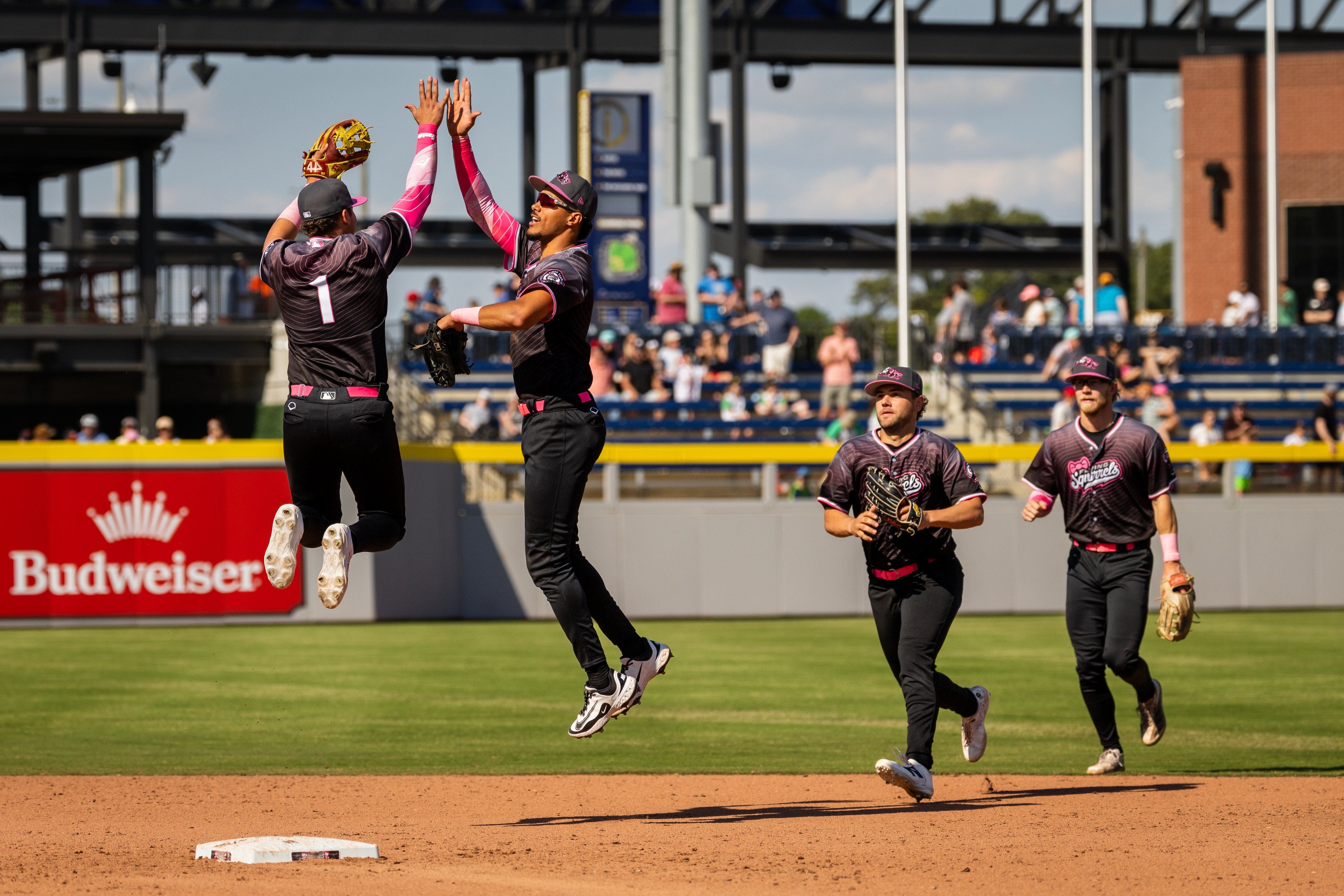
Photo Credit: Mick Anders | Richmond Flying Squirrels
Seeing as we have some dead time this week, with only complex games going on, seems like a good time to stretch out the mailbag and actually try to get to everybody’s questions. You’ve overwhelmed me the last few outings, and I’ve had to leave so many of your thoughts on the cutting room floor. Hopefully, with two bags this week, I’ve gotten everybody attended to! In Part One of this week’s mailbag, we had a little draft talk, and a lot of pitching woes talk.
Today, we get into Rule 5 talk — which does seem to be the over-riding core interest of There R Giants’ subscribers, bless your hearts — as well as a pu pu platter of other topics. Ummmmmm……dim sum. Let’s dive in!
Couple questions from a long-time listener to the pod and a new subscriber! Awesome work as always.
Could we see some prospects traded throughout the rest of the year and offseason with the amount of Rule 5 eligible players the Giants have? It could be the Spencer Miles recency bias, but it feels quite hard to see spots for many of the arms eligible specifically, with Bo Davidson a lock and Drew Cavanaugh, Jonah Cox, Victor Bericoto already on the roster, plus others likely to fill for deadline trades.
Also, has there been talks of a major shift in the Giants’ player acquisition strategy from a standpoint of putting “bigger bets” on higher quality players than in the past, or have we seen just a reaction to the opportunities provided? Examples being the bigger international bonuses of Josuar Gonzalez and Luis Hernández, and the assumed relatively higher bonus needs of the three top pitchers (leading to more senior signs following). Do you think they can sign Kemp and Wentz?
Ken Iverson
Do you expect the number and quality of Giants’ Rule V eligible players to have a significant impact on trades made this month? For example, if it looks potentially challenging to fit all of the roster-worthy players on the roster later this year, might the Giants use a couple Rule V eligibles to sweeten a deal? Or conversely if there are few roster-worthy Rule V eligibles, do you think the Giants could gain better trade return by targeting other teams’ Rule V eligibles?
Well, Tsteele, thanks ever so much for coming over from the podcast side! I’m glad you’re here!
You and Ken have both asked very similar questions regarding the way that upcoming Rule 5 decision points might impact trade discussions. You’re both quite right, this does happen at times! I was actually talking with someone who works for a team in a “buyer” position this summer, trying to get some sense of Luis Arraez’s market value (a very muddy topic), and he brought up this specific idea: they’d be inclined to want to include some arms that they know they are unlikely to protect this fall.
I would not be at all surprised to see the Giants acquire players in this bucket in the coming weeks — as, in fact, they did last year when Trystan Vrieling was a part of the Yankees’ deal for Camilo Doval (though they did not end up protecting Vrieling either). And, in fact, they have already done so this year, in acquiring Matt Wilkinson from Cleveland. Another variation on this idea is that trade talks in July could serve to gauge interest level in certain players that might be revisited come November, when teams with roster crunches tend to make a flurry of small deals along the lines of the Giants’ acquiring Brett Wisely from Tampa a few years ago.
As for the Giants sweetening the pot of potential deals by trading away their own Rule 5 protection candidates, that is an interesting wrinkle on the topic. I will admit that I’m not sure how painful the team’s roster crunch will actually be when the time comes for these decisions. There is a fairly big group of interesting names, with some — Davidson, Whitman, likely Wilkinson — being obvious adds, and others — Marte, Harris, de la Torre — more on the questionable side of things. Cesar Perdomo has certainly done a lot to force the issue on rostering him before he hits his minor league free agency. But the current 40-man strikes me as being so soft that they should be able to get even a relatively large group on come November. There are currently a whopping 27 pitchers on either the 40-man or the 60-day IL, and just looking through there, I can find a lot of potential pruning opportunities, personally. Put it this way: in November of 2021, the Guardians added a stunning 11 Rule 5 protection players to their roster, coming off of a 2nd place finish (and on their way to winning the division the next year). The Giants can find room on their current roster for talented players.
Having said that, the player who is in a really interesting position here is Scott Bandura. He is having his best season as a pro. He was arguably the best player on that early-season Richmond squad that virtually never lost. And he’s a player who I know has a lot of admirers around the industry — indeed, I know the Giants have gotten inquiries about him in the past even before this year’s strong development gains.
But this is one area where the 40-man really could get sticky. With the promotions of Bericoto and Cox this spring, the Giants currently have seven outfielders on their 40-man. Davidson is going to get added; that’s eight. That’s a lot of outfielders for a roster to carry! Can they afford to add a ninth, with Bandura? That, I think, is going to be a real question for them. I can see Scott finding his way into some of these conversations this month — he is a very easy player to like if you watch his all-around game on a daily basis. (The other option, of course, would be to have him take the place of a different outfielder on the roster.)
And finally, Tsteele, as to your question regarding a shift in player acquisition strategies, I would say that it’s more of a response to opportunities presented. I don’t think the Giants have ever particularly shied away from bigger bets (Buster Posey himself is an example of that, as are other folks whose bets didn’t pay off so well, such as Angel Villalona). With the draft especially, so much of what teams can do is determined by the size of their bonus pool, and we’ve seen the team sitting on the lower side of the industry for several of the past draft years. This year, they were up on top and they flexed their muscle — as they did in 2020, when they had a wealth of 2nd round picks. I think they are opportunistic in this way — eager to make the big strike if it’s a realistic option, but happy to spread risk around more prudently if it isn’t.
As for the question of signability, this seems, behind the scenes to have been a huge factor in this year’s draft. There are much better sources for this information than me (Kiley McDaniel at ESPN, Joe Doyle at Over-Slot), but from what I gathered, it sounds like the influence of NIL money significantly impacted conversations going on in the background during the draft. McDaniel mentioned that a lot of teams were saving the 5% overage (MLB allows teams to spend 5% past their allotted bonus pool without penalty) as insurance for getting their college juniors signed, rather than for higher bonuses to high school players. It’s going to be very interesting to see how many presumably “signable” players end up returning to campus this year. I too, am really eager to see them get Kemp inked, as I loved that pick, but all of those 11-20 round players are going to be maybe a little more challenging this year than in previous years — and some of the 5-10 round college players could be a little more expensive than previously imagined as well.
I see William Kempner pitched for Miami last night. Can you take a minute and explain how a Giants third round pick in 2022 went from the Giants selling him in 2025 to a pitcher who has 8 appearances for the Miami Marlins (a competitive major league team) with a WHIP of 0.87?
I guess my real question is why was this guy so mediocre he was dropped from the Giants top 30 prospects three years after being drafted in the third round, yet a little over a year later a team with a considerably better bullpen gets major league innings from him. It feels like a Kyle Harrison saga on a smaller level.
Yes, Kempner is doing well this year, and good for him! I caught him in the Arizona Fall League two years ago, right when he came back from missing the 2024 season, and I can tell you the scout section that I was sitting in that night had a lot of positive things to say about his performance! Plus, he was a really thoughtful and gregarious interview subject. Look at this smile!
But, Dave, I think you’re laboring under something of a delusion here. The Giants didn’t “sell” Kempner, they traded him for something they really needed — international bonus pool money that allowed them to get Josuar Gonzalez signed. Blake Sabol was sent to Boston for the same thing, and between those two deals, they got the Gonzalez contract signed. Thankfully. The Giants had been penalized IFA money that year due to the Willy Adames signing, and, as Giants’ Senior International Scouting Director, Joe Salermo, mentioned on my podcast the day Gonzalez was signed, they also had to fend off a late run from another team to try and steal him away.
They had a need. That need had a value. And to satisfy that need, they had to trade away something of equal value. I do think there is something to be said about Kempner being more of a “Zaidi-type” player. The Giants under Zaidi drafted a lot of those funky low-slot guys (of course, the Giants just drafted a bunch more of them this year, so maybe it’s not just Zaidi). That might have played into the decision to use him for that purpose, rather than someone else in the system. The same could be said of Sabol, who was the ultimate Zaidi player. But if you are thinking that the Giants essentially gave him away because they didn’t see any value there, that’s incorrect. They used the value he had to accomplish a very necessary goal.
As for Kempner not being on the Giants’ Top 30, you shouldn’t read too much into that. Middle relievers don’t make Top 30s. That’s just the nature of prospect rankings — because it’s the nature of industry evaluation. They’re always getting included in deals because they have some value, but not so much value that teams worry about hanging on to them. Point me at a very successful big league bullpen, and I will find you important parts of it that were never part of any team’s prospect rankings.
Kempner was coming off a year lost to injury, and before that, the Giants had done some experimenting with him as a starter. But it was always pretty clear that he was headed for a relief role, and that his funky delivery and extremely unusual movement profile was very likely to fit in a big league pen. You just don’t see right-handed side-armers pumping mid-to-upper 90s with movement a whole lot.
Bottom line: they traded Kempner because he was valuable, not because they thought he wasn’t. They just put that value to use in a different way.
I have always been curious about the balance in development between “let the player do what they do best” and “help them make changes to maximize their potential and performance”. A write up on Trevor Cohen in Fangraphs brought this to mind again, as they note he might need a swing change to get out in front a bit more to do more damage. In your experience, how does the current Giants’ system balance those two things or prioritize them?
Hi JK, that’s a great question!
I guess I will just start by saying that the goal is to make each of these players the best version of themselves that they can be. No matter what player you’re talking about, they need to make changes if they are going to succeed in the major leagues — even major leaguers need to make changes constantly.
However, you get at something important, which is determining the best type of changes for each player. The biggest thing that every player needs to learn about themselves (and where organizations or outside consultants can really help them) is understanding how their body moves most efficiently. Knowing how they generate force, how they can get into position to generate force and trigger that force most effectively — these are critical and foundational pieces to any player being the best they can be. Every player has their own swing or their own pitching mechanics which is unique to their body — and there’s really only so much that anybody can do to change that basic setup. Just like pronators and supinators can never be coached into being the opposite, hitters have a certain amount of swing mechanics that are bred in the bone from the way their bodies move, and all development has to work in coordination with that innate physicality.
But within that, there are still many types of adjustments and changes that can be made. A hitter might have a certain swing that is innate, but you can tinker with the load and the trigger — with getting their bodies into more efficient position to fire. Stand up straighter, crouch down, open up, toe tap, leg kick — all that stuff fits into this bucket. For several years, for instance, Heliot Ramos — who has tons of bat speed — was having an issue in 2021/22 with being late on fastballs, leading to a lot of hard ground balls the other way. The issue was that he was stiff in his setup and wasn’t clearing his hips so that his hands could fire through the zone (I actually think that both Davidson and Jordan have a little of this issue in their swings as well that will involve future work). But, after a lot of hard work in Sacramento (much of it thanks to the help of Damon Minor), he found a fix to the issue — one that worked with who he is, but also allowed him to maximize his performance.
Point of contact, which is really what you are talking about with the example of Cohen, is, I think, a little more of an approach and an intent issue than a mechanical one — and it’s one of the primary things that players are constantly tinkering with even in the major leagues. Changing where a hitter is trying to intercept the ball — and thus, when his decision point needs to come — is a primary way that players fine tune their power/hit balance. A lot of teams have focused heavily on the area of pulled fly ball rates in recent years (which is a function of getting out and meeting the ball in front of the plate), because data shows that this is the most effective way of getting to home run power, and, even if there is a trade off with contact there (earlier swing decisions lead to more bad swing decisions), the increase in home runs makes it worthwhile. Old friend James Tibbs III, by the way, is a great example of this kind of hitter. His hit tool is probably below average, but he’s become very adept at getting balls in the air to the pull side, and will live and die by the power he generates, and live with the strikeouts that come with it.
But what of guys like Cohen, who aren’t going to make a living on their power potential? And how do the Giants balance these two things?
The Giants are definitely not a “one size fits all” organization when it comes to development. They are happy to let players be who they are, and aren’t trying to shove everyone down the exact same “skills acquisition” shoot. Just to take one example, in a world where so many teams do focus on pulled fly ball rates, it’s amazing to see how many players the Giants have who specialize in hitting fly balls the opposite way (Davidson, Harber, Cox, Cavanaugh, Bandura, Jordan, and others are all, to one degree or another, heavy opposite field approach guys, as is Ramos).
But even with that, they are certainly working to help their players maximize their ability — and that means getting the ball off the ground and into the air (a topic much discussed with regard to the just drafted Peyton Bonds, for instance). This was a topic that came up repeatedly in some conversations I had with Giants’ players this spring. Carlos Gutierrez mentioned it as a priority for the upcoming season when he was on the podcast back in February, and Cohen himself touched on the subject when I spoke with him before the Spring Breakout game. I’d really recommend you rewatch this interview that I had with Bandura at the start of the season, because he — Ivy Leaguer that he is — was especially articulate in getting at the how and why of adjusting point of contact, and the statistical evidence that the Giants used to get him to buy into making an adjustment. Neither Cohen nor Bandura is ever going to be a slugger — and an all-fields approach serves them best. But the Giants want to see them get to the best of their capabilities, which involves understanding how their swing works and getting the most out of that.
I see that Reggie Crawford has been keeping busy by DH’ing in the Arizona Complex League. What’s his overall outlook at this point?
Reggie and the Giants are both hoping to get him back on the mound eventually, but the longer that continues in the “hoping” category, well…..shoulders are tricky. Right now, the pitching progressions are on hold. He’s gone through two different shoulder surgeries, and it sounds like he’s still just not feeling good about throwing yet. As long as that continues to be true, then having an avenue that allows him to get on the field and be athletic and play the game that he loves is a real benefit.
I am really curious what you think the future is for Victor Bericoto and Casey Schmitt on this Giants’ team, and if they have made enough adjustments, relative to their time in the big leagues, to be long-term solutions. Thanks, Roger, for the good reads.
Ah, the future. So tricky to predict, isn’t it? How quickly do we find ourselves flipping from “this guy is a foundational piece” to “maybe they should trade him” and then back again in whiplash-like fashion from year to year or even month to month?
In different ways, I think that Schmitt and Bericoto are two of the happiest stories of the season — and great examples of the idea that every player has his own journey. From my Richmond-centric perspective, Schmitt was there and gone in the blink of an eye: 29 total games in the late summer of 2022, and he’d be in the majors just a couple of baseball months after that. Bericoto came to Richmond almost exactly a year later, and then fell into something of a Double-A purgatory, laboring in the level for two and a half years before he really found the key to push his game to new levels. And yet, here they both are, not exactly in the same place in their careers, but both contributing positively in the big leagues in 2026.
Schmitt, to me, has definitely done enough to say that he is established now as a good everyday player. We’ll see what the second half brings, but my read on his first half is that this has punched his ticket to a fairly lengthy career as a regular player in the big leagues. He’s worked hard to improve his swing decisions over the years — though he still does backslide, and that’s something he’s going to have to stay on top of. In that two-month period in which he didn’t walk a single time, his OBP was .280, which obviously is not a sustainable level of out-making. But he’s shown a continued ability to get to his raw power, and his ability to move all over the field is a huge value to the roster — there will always be injuries — and a credit to who he is as a teammate.
I am, I will admit, a little interested in how he gets to as much power as he does with bat speed that is well below where nearly all 30-HR hitters live (75 mph is usually the red line there; Schmitt’s is closer to 72 mph), and perhaps swinging too much is part of the compromise necessary for getting to that power — just the price of doing business to some degree. But he has unlocked the ability to maximize his barrel rate — to return to the conversation above, he has really perfected the ability to intercept the ball out in front of the plate and launch pulled fly balls. I would imagine there will always be some hot/cold to Schmitt’s hitting — it’s impossible to walk 2% of the time and not have some real cold stretches that come with that approach — but he’s done enough the past two years to believe that he has truly established a new baseline of performance as an above average major league starter who can truly play anywhere (even pitcher!). That’s a pretty valuable player! It’s taken a while for him to get here, but this is a tremendous development story! For as much as people complain about Giants’ drafts of recent vintage, they really killed that 2020 class in what was easily the most difficult draft to scout that has ever been.
Bericoto’s success thus far, I will just say, makes me happier than anything else that has happened this year. Almost exactly a year ago at this time, I had consigned him to walking out the door at the end of the season. He was heading towards minor league free agency, and a real slump in Richmond following an IL stint (and an unfortunate demotion from Sacramento to make way for Bryce Eldridge) had me thinking the Giants were likely to let him go. But he made the case for bringing him back with his play on the field over the final two months of the season — he was focused, he was disciplined, he was everything the Giants could want to see — and he has taken advantage of every opportunity to come his way this year.
That said, it would hardly be shocking to see Victor go through some of the same adjustments that Schmitt has had to make the past couple of years. Like Casey, Bericoto has been pretty allergic to walks so far in the majors (1.7%). Now, some of that is just being a young player in the majors — pitchers aren’t going to corner pitch you until you prove to them you can hurt them in the center of the plate. But a certain nature of over-aggressiveness has always been part of Bericoto’s game, and he’s succeeded best when he curbed that enthusiasm.
It’s funny how many similarities the two really have. They both hit the ball very hard (Bericoto produced a 118-mph EV as a very young player in the system a few years back), but haven’t always maximized their power potential in the minors (although Bericoto did have one big power year). They both are up there to swing, and have to force themselves to stay in the zone. Like most right-handers, same-sided sliders are kryptonite. I would guess that the key to Bericoto having sustained success in the majors is going to be similar to the adjustments we’ve seen from Schmitt — he’s probably going to need to get to more of his pullside power (he’s always had very low pulled fly ball rates), and he’s going to need to fine-tune his aggressiveness so as to not make himself an easy out for pitchers outside the strike zone. But the simple fact that we’re talking about adjustments needed for him to stay in the majors — as opposed to getting to the majors — is a huge positive step!
And I guess I will just state here that I think we need to reign in this offhand narrative that people keep repeating that the Giants have trouble developing hitters. Eldridge, Ramos, Schmitt, Bericoto — these are all genuine development success stories, and from dramatically different tiers of prospect talent. Davidson is trending towards becoming one. The improvements we’ve seen from players like Cox, Cavanaugh, Bandura, my old fave, Turner Hill, and others this year have been impressive as well — none of them are likely to be any kind of offensive stars in the majors, but hitting enough to allow their other skills to be useful is a giant win for them and the organization. There have been a lot of positive development stories the past couple of years, and we need to start incorporating that into the way we think about the organization.
I was listening to the BA pod, and they were talking about how the Rays — a low-payroll team — have an army of scouts. Likely not coincidentally, they have a fantastic farm system (BA ranked them #2). Where do the Giants sit in relation to other organizations in terms of the size of their scouting team? Also, investing in more scouts seems like a fantastic approach since I am guessing the pay is modest in the context of the cost of running an entire organization. Why don’t all teams deploy an army of scouts? Is there some negative effect besides needing to pay them?
Paying scouts is the only real negative from owners’ perspective — and for some of them it’s a real negative — but, to be fair, I should say that there are some executives who philosophically believe that pro scouting — and it’s important to make that distinction — can be done as effectively without in person looks, through video and data analysis. Jeff Luhnow, both at St. Louis and Houston, definitely held that opinion, and David Stearns, who worked under Luhnow at Houston, took that philosophy with him to Milwaukee. The Giants, in fact, have an entire cohort of former Brewers’ pro scouts who got out before that department was more or less dissolved (coming over with now-GM Zack Minasian). Given the Brewers’ success, it’s fair to say that both of these approaches can work, given the right execution.
But yes, Tampa Bay has always famously employed a large phalanx of pro scouts (some of whom I’ve gotten to know and really like over the years). They trust and value their scouts’ input, and, what’s more, that organization probably set the industry standard for having collaborative working relationships between their disparate departments. They actively worked to increase and improve cross-departmental communication and collaboration in a way that has proved hugely beneficial over the years. Where some clubs can get into some combative cross-departmental relationships, the Rays figured out early on how to get the best out of everybody — and that’s a foundational truth that Andrew Friedman took with him to the Dodgers, who also employ a small army of pro scouts (I’ve also gotten to know and really like some of them over the years).
I do keep saying “pro scout,” so it’s probably important here to note the distinctions. All teams have three different (usually separate) scouting departments: international (the guys looking for Luis Hernández in Venezuela, or future Shohei Ohtanis in Japan), amateur (the ones who run the draft, scouting American colleges and high schools), and pro (who evaluate players already in professional baseball, both in the minors and majors, for potential trade acquisitions). There used to be a fourth type — advance scouting. Those were the guys who would go sit on a team that their club was going to play next week, and send back notes for preparation. Kirk Gibson knowing that Dennis Eckersley liked to throw the backdoor slider in a two-strike count was something that came from an advance scout. But that type of scouting really does seem to have been killed off by the ubiquity of information on everything that happens on a big league diamond today, which is a little sad.
When people talk today about the size of scouting departments from team to team, they are primarily discussing pro scouting, because that is the scouting area that technology has put increased pressures on. The nature of international scouting and amateur scouting is such that you still have to have boots on the ground — even though the amount of available data is much greater than it used to be, you can’t simply cover a draft or cover the world of international amateur baseball without scouts at the field (though if you eliminated high school players from the draft, a lot of teams would instantly start cutting amateur staffs as well). But because all teams can quite literally look up all the data they need from every minor league player, and get all of their video at bats at a touch of a button (with systems that I would really like to have at my disposal if any of my rich readers would like to gift me tens of thousands of dollars), the value of pro scouts has come under attack. When I was in Arizona last month, I was talking with a pro scout from an AL team who said he’s one of just two left in his organization.
The Giants currently have a 10-man pro scout department. That’s more than two! On top of that, they have a couple of special assistants who flow seamlessly between pro and amateur scouting, as the need may be (John Barr, for instance, does both for the team). And it’s to Posey’s credit that he put budget money for that pro scout department back into the budget after Zaidi had eliminated several positions a month before he himself was eliminated. But that’s still only half as many as the 19-man department the Rays run. The Dodgers have so many titles that it becomes a little difficult to tell where there pro scouting department ends, but I think they have about an 17-man staff.
I would say that there is a glass half full/half empty effect here. The Giants just last year picked up some well-regarded pro scouts from other clubs who were gutting their own departments (Miami, Chicago Cubs), which is a big feather in their cap in my eyes. But you could also look at the Rays and say “why can’t we have as many scouts as them” and you’d get no argument from me. Generally, however, I think the Giants’ pro scouting group has served them well for the past several years — they’ve been part of a process that has uncovered such undervalued players as Mike Yastrzemski, LaMonte Wade, Jr., Jesús Rodriguez, and Parks Harber. That’s doing some fine work! And I don’t think I’ll be hearing a Giants’ scout bemoan the fact that he’s the last man standing in the department any time soon.
Great content over the last week, Roger. I’m looking forward to what you have in store during the break, too. Why do you feel Dakota Jordan was picked for the Futures game instead of Bo Davidson? My read is Bo’s had the better season — at a higher level — and he’s generally the higher-ranked prospect.
You know, Scott, that’s actually a terrific question! Davidson would have fit nicely on the Futures Game roster — and though there are a lot of different push-pull pressures on crafting together that roster, as they are both NL outfield prospects one might imagine they’d be interchangeable. And, yes, I would agree with you that Davidson has been having the better season — in large part because of the differing levels of competition.
This is purely conjecture, but I can see a couple of factors that may have been at play here. One, and this is probably pretty minor, is that there is kind of a cool narrative involved in “the two teammates fly from Eugene to Philadelphia….and then stay on the east coast for a bump up to Richmond” story. Easy on the logistics, too!
But I think the other thing is, counter-intuitively, the fact that Davidson is the higher ranked prospect may have worked against him in this case. He already has the cache that comes from being on Baseball America’s Top 100. And I know there are people in the Giants’ organization who feel, intently, that Jordan should be there, too. I’ve had the case put to me quite passionately by an upper-level member of the organization that Jordan is a very similar prospect to the Dodgers’ Zyhir Hope (currently #55 on BA’s Top 100) and should be ranked similarly.
I do wonder if there was something to that decision of wanting to advocate within the broader prospect world for two players who aren’t getting quite the same level of hype and love as guys like Gonzalez and Hernández and Level and Davidson, but whom the Giants feel are just as talented. Again, total conjecture on my part, but I can see it making sense.
Hi Roger, thank you for all the draft insight. My questions are as follows:
How many of these new pitchers do you feel will be given the green light in San Jose, once signed? Will Flora or Boleman be shut down?
Finally, do you see any chance that Jhonny Level makes it Richmond this year? I know he’s having some struggles in Eugene, but he still seems to be improving weekly.
We’ll end this two-part mailbag where we started: with a late-breaking draft question (way to get it in under the wire, Matt!).
As I wrote yesterday, as the draft has shifted back later in the year, it has become much more common for teams to hold off their pitchers’ pro debuts until the following spring. That doesn’t necessarily mean they will be shut down, but what game action they get is more likely to come in the controlled, and mostly unseen environment of late-summer camp games at Papago Park. Getting them into the facilities and programs, and establishing development plans for them going forward is the real work to accomplish over the next couple of months. Remember when Maui Ahuna said that the team sat down with him and mapped out a plan for adding some 50 lbs of muscle to his frame over time — this is the time where that kind of thing happens.
I would highly doubt that we see either of the high school pitchers this year, and if we see Flora at all, it would probably very limited at the end of the season. Last year, nine of the 11 pitchers taken in the 1st round across MLB did not debut in-season. So, I’d just keep those expectations as the new industry norm.
As for Level, there is certainly always a chance that a player might move up a rung. What Level is doing as a 19-year-old in Eugene is certainly impressive — he’s hitting .300, seems to produce a double a day, and has been strong defensively. That said, I don’t see any compelling reason to push him further this year. There are things you can see he needs to work on — he’s chasing a bit more at this level, and the walk rate has plummeted. And the decline in home run power in the NWL could be an indication of some fatigue levels setting in as the 5’9” player endures his first six-month season.
I would say that one possible scenario that could push him up to Richmond is this: IF at the end of the season, the club has determined that they have seen enough from him in Eugene that they are likely to assign him to Richmond next spring (not a given, I would think), then they might do what they did with Marco Luciano back in 2022, and promote him after the NWL Championship series is concluded in time to participate in the Eastern League playoffs. That’s just a pure guess on my part. We’ll see what the real decision-makers have in store for us over the final two months of the season.
Alright, and with that we’ll close down the There R Giants’ post office for the week. I should probably mention that the mailbag will have a period of hiatus in August, as I will be on assignment for a couple of weeks at the start of that month. So, if you have burning questions, best to get them in the next couple of weeks.
Look for a draft-themed podcast coming later this afternoon. It’s a good one! And tomorrow I’ll be back with my picks for the First Half Organizational All Stars.
Seems that Trevor Cohen moving to Richmond too.
Roger again thank you for the work you do here. I wish fans would realize how this organization is turning it around. How much effort it takes. The old story of this organization doesn't develop is now getting to be ridiculous to me especially seeing how the young players are advancing. It's jot an easy game to begin with and the odds of players actually making it to the majors is crazy. Even the so called best don't always produce.